


No products in the cart.
Return To Shop
A chilli can bring colour, fruitiness or smoke to dinner before you even think about its heat. Choosing only by how fiercely it burns leaves plenty of flavour out of the conversation.
This guide compares familiar Indian chillies with global kitchen favourites. It covers heat in Scoville Heat Units, flavour, regions to look for and dishes where each can work. It also separates a famous regional name from verified geographical protection.
Research and GI status checked on 13 October 2026. The heat figures below are reference points, not a guarantee for every packet. Where a number is only a supplier estimate, we’ve marked it.
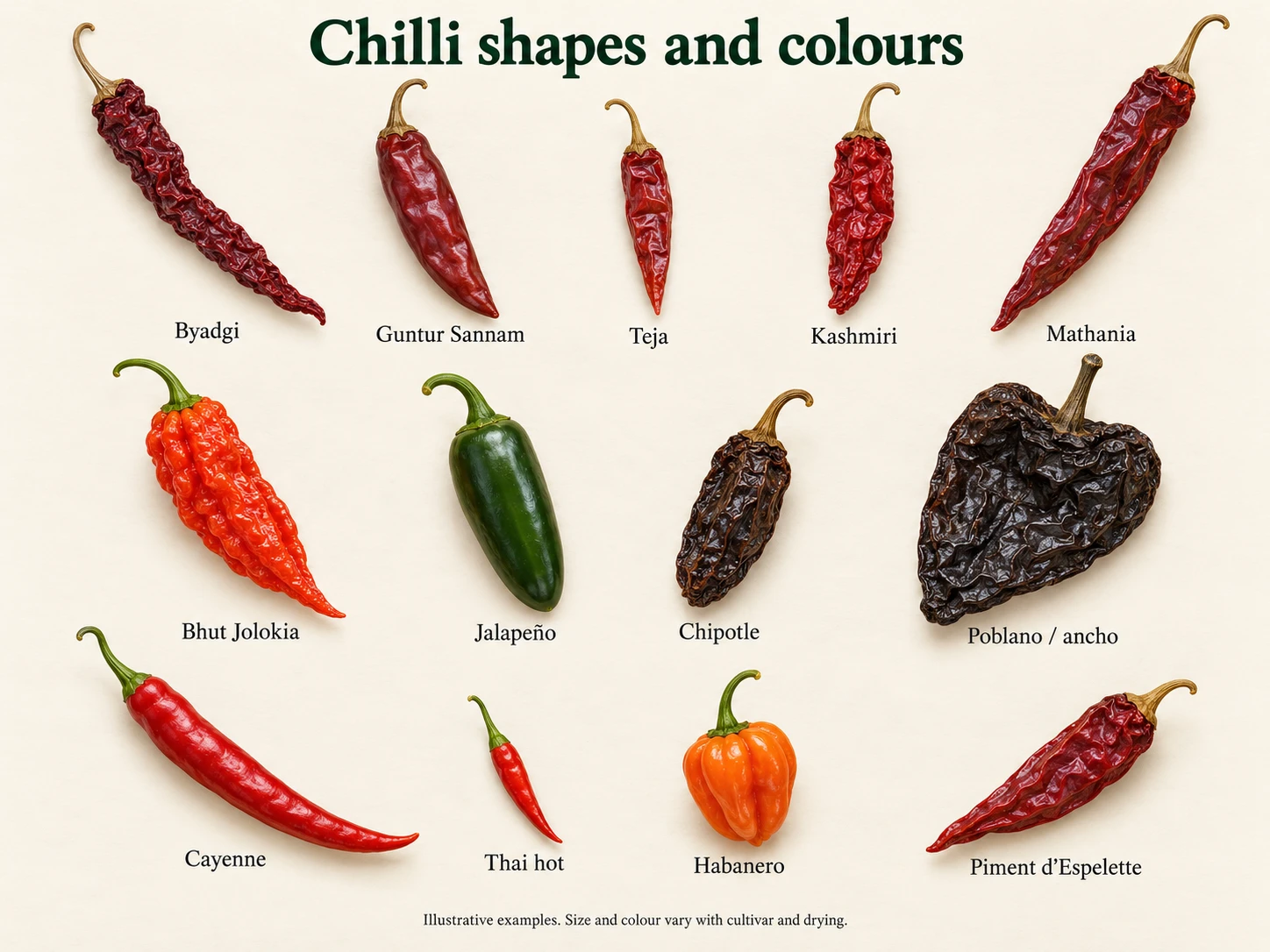
Compare chilli shapes and colours
What SHU actually tells you
SHU stands for Scoville Heat Units. It describes pungency from the chilli’s capsaicinoids. It doesn’t measure redness, sweetness, aroma or whether you’ll enjoy the finished curry.
New Mexico State University explains that genetics and growing conditions both affect heat. Modern laboratory testing can measure capsaicinoids using HPLC. A lot-specific test is more useful for buying consistent heat than a broad variety name.
Fresh pods, dried pods, powders and blended sauces are different products. Don’t treat a teaspoon of fresh chopped chilli as interchangeable with a teaspoon of dried powder.
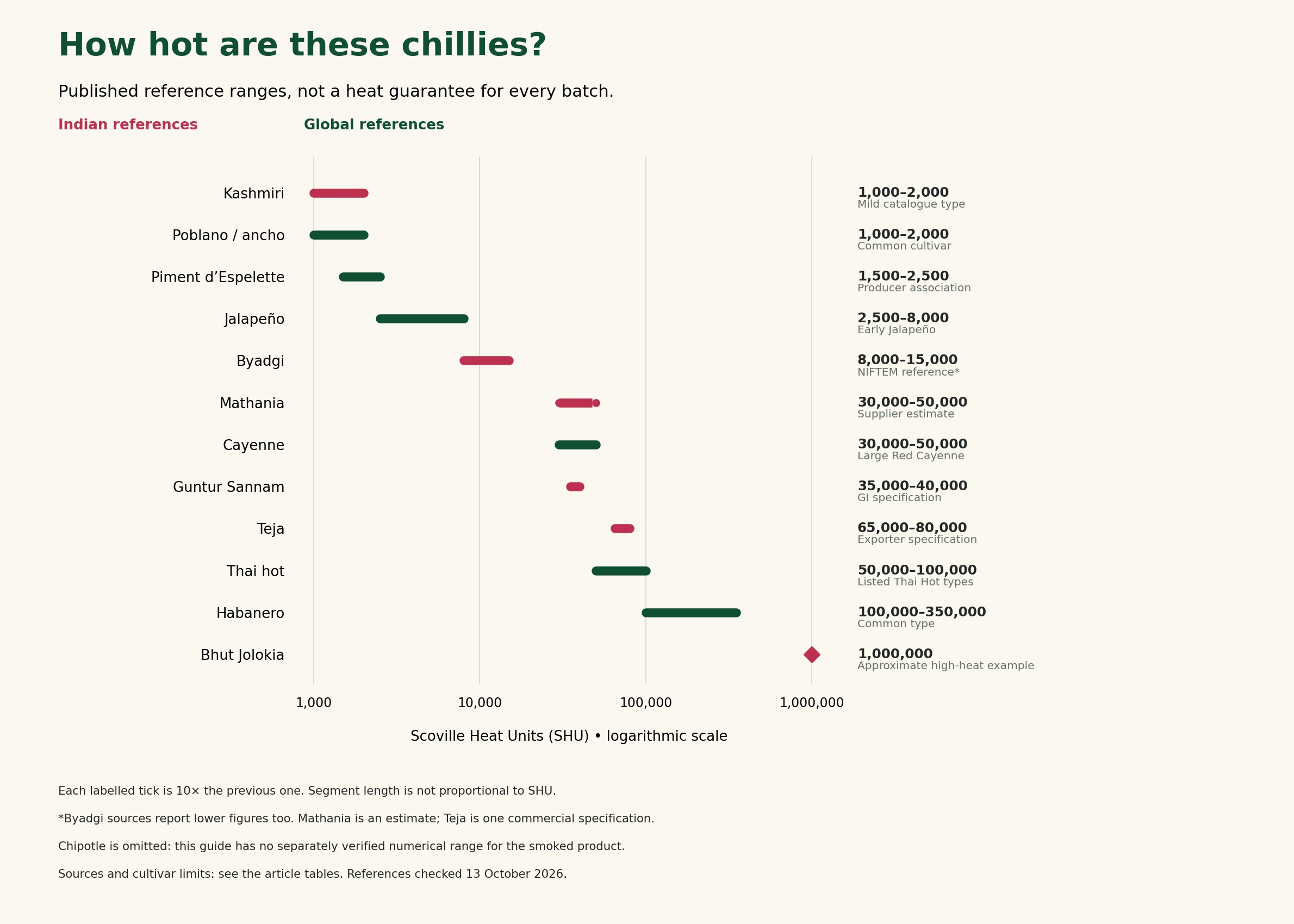
Compare chilli heat at a glance
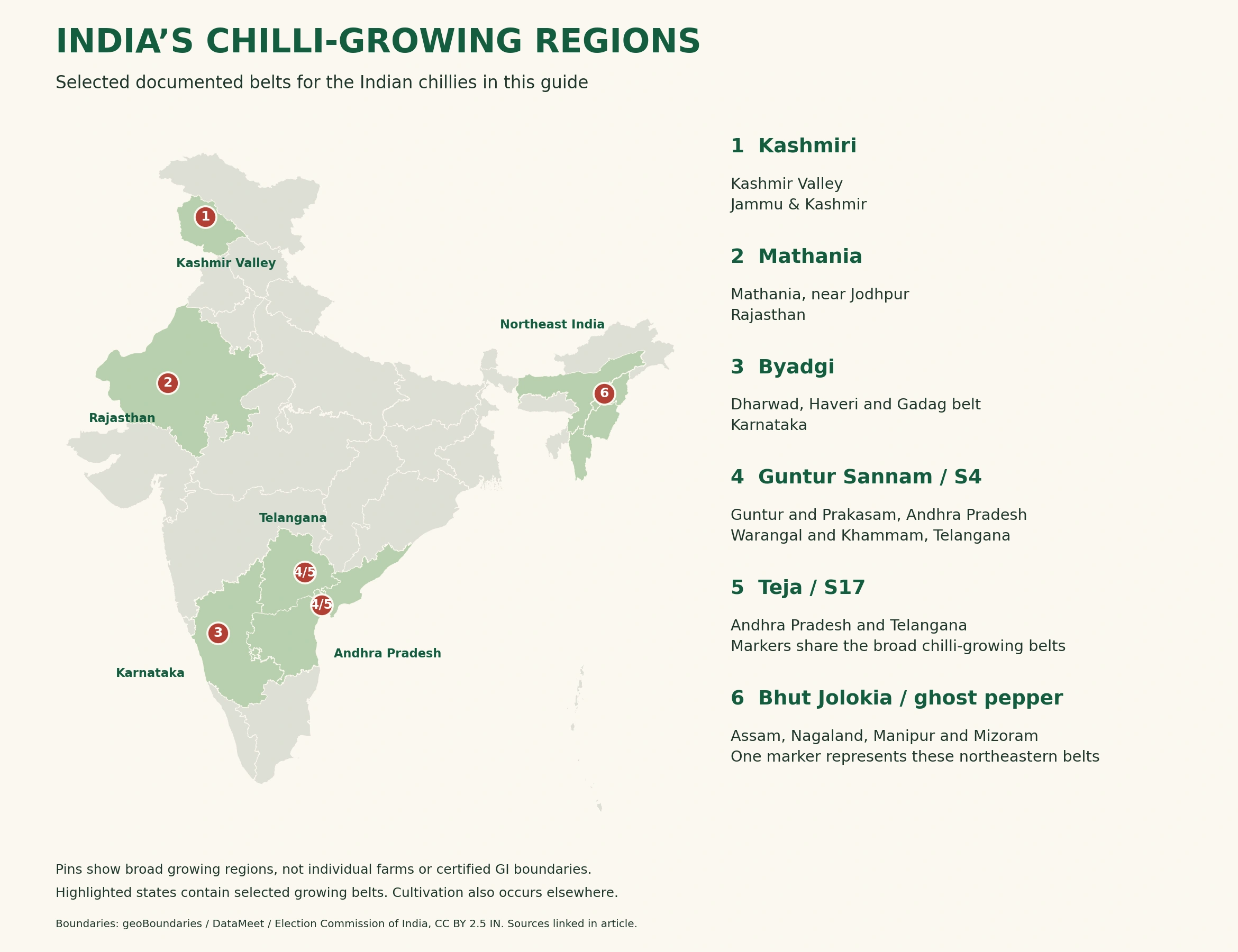
Where these chillies grow
A chilli’s name can point to a place, but it doesn’t tell you everywhere that chilli grows. These maps show selected documented growing belts for the varieties in this guide. The numbered keys help you match each chilli with its region.
India: chilli-growing states and regional belts
World: regional homes for familiar chillies
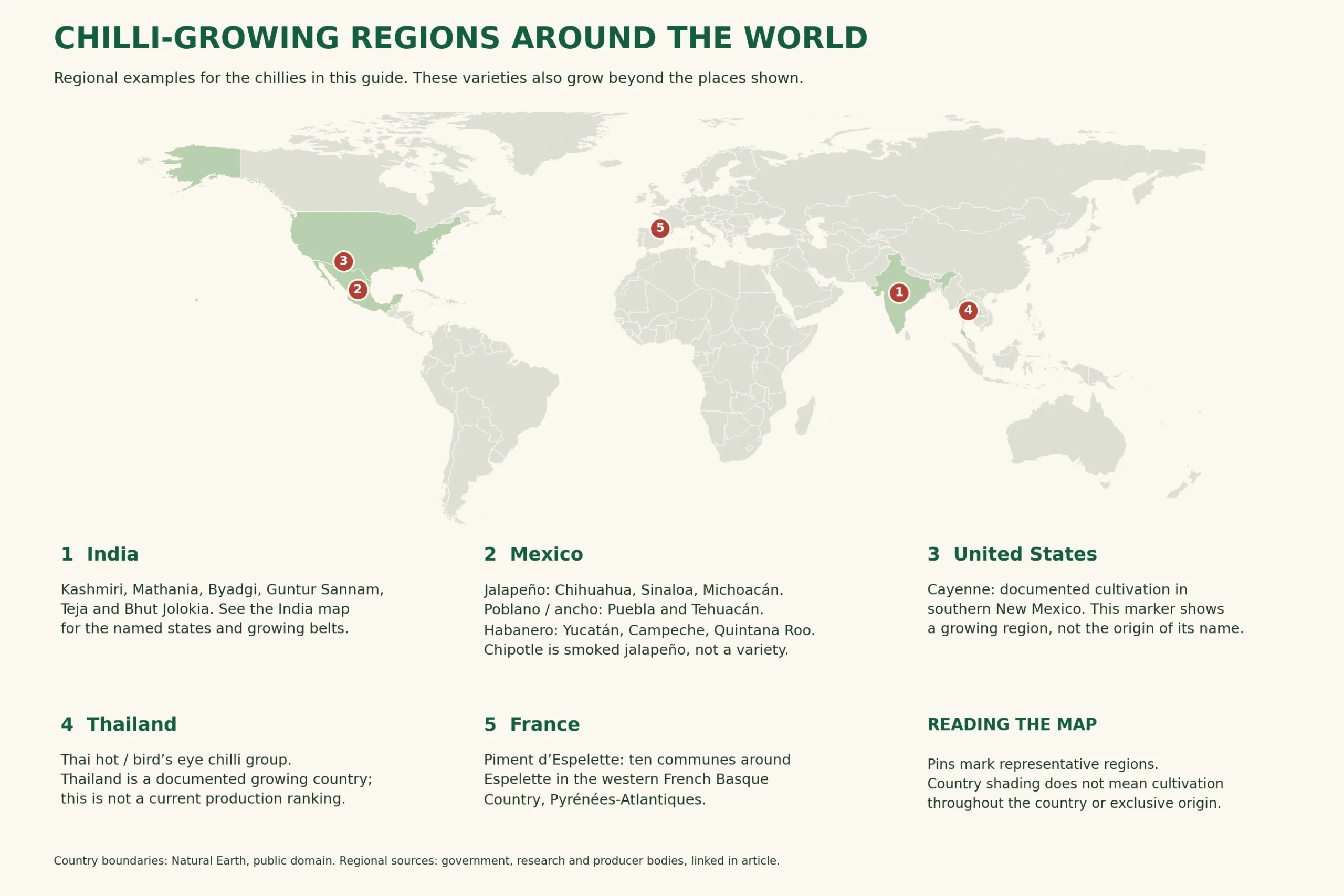
Map sources, checked 14 October 2026: Spices Board guidance on Byadgi and Guntur Sannam, Guntur district chilli information, ICAR on northeastern ghost chilli cultivation, Kashmir Valley chilli research, and the Mathania GI application. Global regions follow Mexico’s jalapeño information, poblano growing heritage, habanero regional information, New Mexico State University’s chile research, FAO’s historical Thailand cultivation overview and the Espelette producer association. The Thailand source documents cultivation rather than current production rankings.
Map boundaries: geoBoundaries, using DataMeet and Election Commission of India data under CC BY 2.5 India; world boundaries from Natural Earth, public domain. State shading identifies selected growing belts within those states.
Indian chillies: a quick heat reference
| Chilli | SHU reference | How to read it |
|---|---|---|
| Byadgi / Byadagi | 8,000–15,000 in a NIFTEM project reference; lower figures appear elsewhere | Colour-led and usually relatively mild. Subtype and lot matter. |
| Guntur Sannam / S4 | 35,000–40,000 | Spices Board GI specification reference, not every chilli traded through Guntur. |
| Teja / S17 | 65,000–80,000 in one exporter specification | A commercial specification; other suppliers quote different ranges. |
| Kashmiri | 1,000–2,000 for a mild seed-catalogue variety | Not a ceiling for all products sold as Kashmiri powder. |
| Mathania / Mathaniya | 30,000–50,000 estimated by one seed supplier | No universal verified range established here. Ask for a batch result. |
| Bhut Jolokia / ghost pepper | About 1,000,000 for famous high-heat examples | Growing conditions and individual lines can produce much lower results. |
Sources: NIFTEM’s Byadgi reference, Spices Board GI specifications, Teja exporter specification, Kashmiri seed catalogue and Mathania supplier estimate.
Byadgi: start with the Karnataka growing belt
Region and sourcing: Karnataka, particularly the Dharwad, Haveri and Gadag belt identified by the Spices Board. Byadgi is also a major trading name, so a market address alone doesn’t prove where a lot was grown.
Flavour and dishes: Deep red colour with a rounded dried-chilli character. A useful choice for podi, chutney powder and Karnataka-style gravies. It isn’t automatically smoky; smoke depends on processing.
Quality and protection: Ask which subtype you’re buying, such as Kaddi or Dabbi, and check the colour and heat of the lot. Byadagi Chilli is a registered Indian GI. A high-colour batch and a high-heat batch aren’t the same quality target.
Guntur Sannam: name the variety, not just the market
Region and sourcing: The Andhra Pradesh Guntur belt is the familiar starting point. Guntur trades many chilli varieties, so “Guntur chilli” is less precise than “Guntur Sannam S4.”
Flavour and dishes: A direct hot red-chilli character that works in Andhra-style curries, pickles and spice blends. Use it when heat is part of the dish’s purpose.
Quality and protection: Guntur Sannam Chilli is a registered GI. Ask for the exact identity and a heat result when consistency matters. The registration doesn’t cover every chilli sold in Guntur.
Teja: useful when you want stronger heat
Region and sourcing: Teja, often traded as S17, is associated with the Andhra Pradesh and Telangana chilli trade.
Flavour and dishes: Strong, direct heat for hot sauces, pickles and blends where a little should go a long way. It can overwhelm a mild dish if substituted spoon for spoon.
Quality and protection: Compare the supplier’s actual specification and sample. Don’t borrow Guntur Sannam’s GI status for Teja simply because both pass through the same market.
Kashmiri: colour is useful, but the name needs checking
Region and sourcing: Kashmir and the north-western Himalayan growing region are the provenance to ask about. “Kashmiri-style” or “Kashmiri powder” on a retail pack may describe a product sold for colour rather than documented valley-grown pods.
Flavour and dishes: Mild types offer red colour and gentle dried-chilli fruitiness. They suit tandoori marinades and colour-led gravies, including rogan josh-style preparations.
Quality and protection: Ask whether the powder is a single variety or a blend. No specific Kashmir chilli GI registration was verified in this research. Don’t confuse Kashmir Saffron’s protection with chilli protection.
An ICAR study of Himalayan breeding lines reported 16,000–64,160 SHU and described substantial variation. Those research lines aren’t a retail Kashmiri-powder standard; they show why regional names don’t guarantee one heat level.
Mathania: be specific about “Rajasthani chilli”
Region and sourcing: Mathania near Jodhpur, Rajasthan. “Rajasthani chilli” is a broad label; ask whether the seller means Mathania and whether the lot is traceable to that growing area.
Flavour and dishes: Known in the kitchen for red colour, aroma and noticeable heat. Laal maas is a familiar culinary association. Choose a small trial quantity before using it in a big curry.
Quality and protection: The heat estimate in the table is a supplier claim, not a measured universal standard. Two relevant GI applications, numbers 1490 and 1533, showed Examination on the registry when checked. An application is not an awarded GI.
Bhut Jolokia: much more than an everyday chilli swap
Region and sourcing: North-east India. Look for a named cultivar and traceable producer rather than treating every “ghost” label as identical.
Flavour and dishes: Fruity and intensely hot. Small amounts are used in hot condiments, pickles and regional preparations. It’s a poor spoon-for-spoon replacement for Kashmiri or Byadgi.
Quality and protection: Naga Mircha has a distinct registered regional identity; don’t label every Bhut Jolokia grown elsewhere as that GI product. Nagaland’s official district report lists Naga Mircha among its GI crops. The ICAR paper linked above also reports much lower Bhut Jolokia heat under a different growing climate.
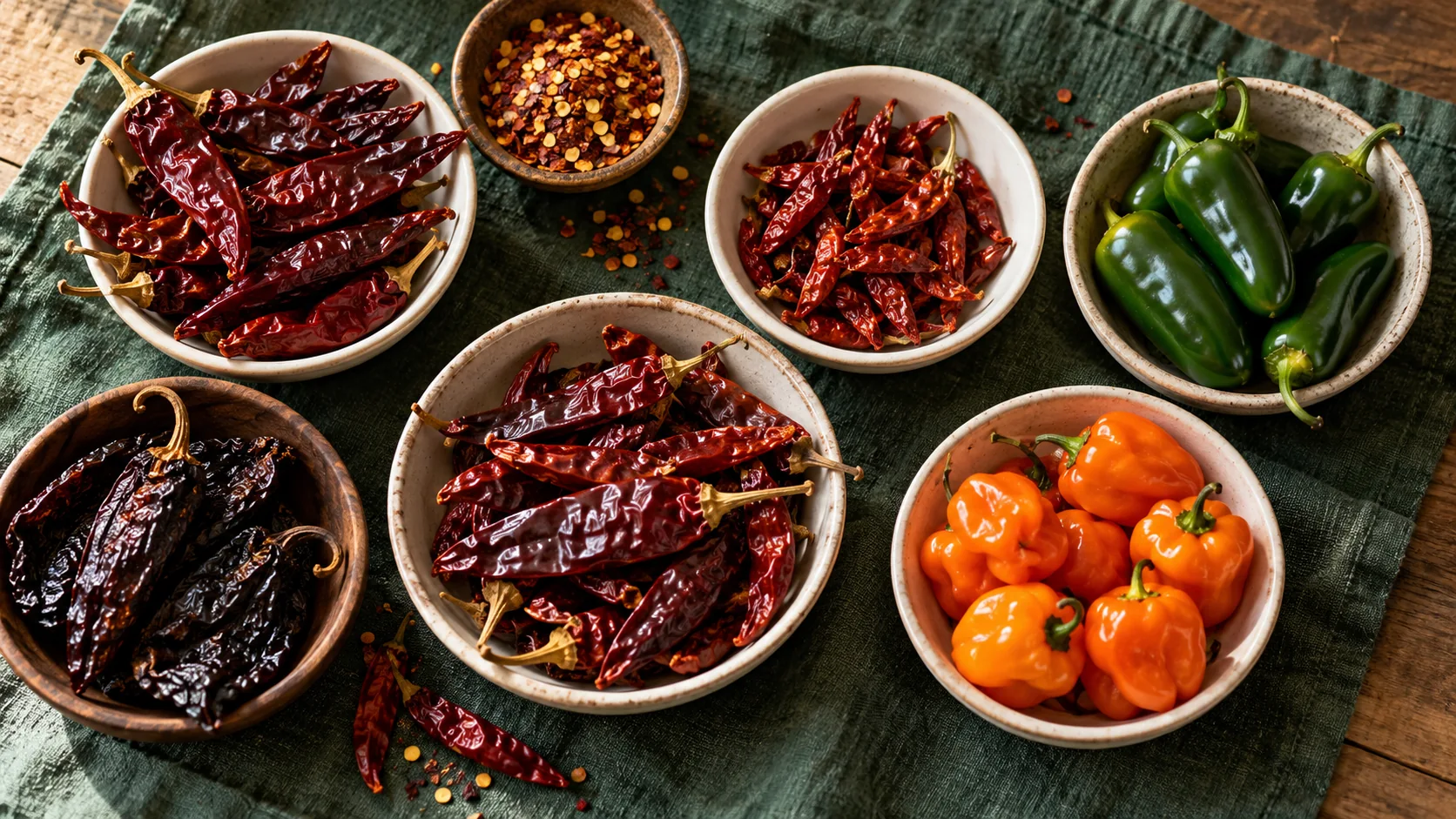
Global chillies: heat with different personalities
| Chilli or product | SHU reference | Regional association and form |
|---|---|---|
| Jalapeño | 2,500–8,000 for Early Jalapeño; other cultivars vary | Mexico; usually fresh or pickled |
| Chipotle | Jalapeño-based and variable; no separate standard assumed here | Mexico; ripe jalapeño dried with smoke |
| Poblano / ancho | 1,000–2,000 for a common seed listing; hybrids can be hotter | Mexico; poblano fresh, ancho dried |
| Cayenne | 30,000–50,000 for Large Red Cayenne; other cultivars vary widely | A global pod type, associated by name with Cayenne, French Guiana |
| Thai hot / bird’s-eye types | 50,000–100,000 for listed Thai Hot types | Thailand and South-east Asia; a group, not one fixed cultivar |
| Habanero | 100,000–350,000 for a common type | Strong association with Mexico’s Yucatán Peninsula; grown elsewhere too |
| Piment d’Espelette | 1,500–2,500 in the producer association’s English guide | French Basque country; protected regional product |
Heat references: Burpee’s cultivar-specific chart and the Espelette producer association. Chipotle is a processing form, so use the supplier’s declared SHU rather than assuming smoking sets a fixed number.
Jalapeño and chipotle
Fresh green jalapeño has a bright, green-pepper character suited to salsa, nachos and pickles. Chipotle brings smoke and a deeper ripe-chilli taste to adobo sauces, beans and marinades. The University of Arkansas guide confirms chipotle is smoked red jalapeño.
For quality, buy firm fresh pods or clearly identified dried/canned chipotle from a traceable producer. Mexican provenance can help you find traditional processing, but a country name alone doesn’t prove a better batch. The generic names aren’t GI certificates.
Poblano and ancho
Poblano’s mild, green flavour suits stuffed peppers such as chiles rellenos. Dried ancho brings an earthy, dried-fruit character to mole and sauces. Ancho is the dried form of ripe poblano, not a separate heat-only substitute for Indian powder.
Mexico is the useful culinary sourcing reference. For dried pods, look for clean, aromatic flesh without dampness or mould. Check the cultivar if you need predictable heat; poblano hybrids can be much hotter than the common reference.
Cayenne and Thai hot types
Cayenne powder gives a straightforward hot-chilli finish to soups, sauces and rubs. Thai hot types bring a sharper fresh-chilli character to curry pastes, stir-fries and dipping sauces.
For cayenne, the exact cultivar and processing lot are more useful than insisting that it must come from the city in its name. For Thai dishes, look for the intended local chilli type and fresh condition. Neither broad name proves geographical protection.
Habanero
Habanero’s fruity, floral character suits hot sauces and fruit-based salsas. Its heat is substantial even when the fruit looks small and cheerful.
For protected provenance, ask for Chile Habanero de la Península de Yucatán. Mexico’s government confirms its denomination of origin. That protected name applies to the specified regional product, not every habanero grown worldwide.
Piment d’Espelette
This French Basque pepper offers fruity and toasted aromas with measured warmth. It works as a finishing seasoning for eggs, fish and vegetables, or in Basque-style dishes.
For the regional product, look for the AOP/PDO identification and an authorised producer in the designated area. The French INAO record and producer association are the references. Espelette-style peppers grown elsewhere aren’t automatically the protected product.
GI, PDO and geotagging are different things
A geotag can record a location. A Geographical Indication protects a named product linked to a defined place and specification. PDO/AOP and Mexico’s denomination of origin are their own systems; they aren’t interchangeable logos.
Verified Indian registrations here are Byadagi Chilli and Guntur Sannam Chilli. The Mathania checks are application 1490 and application 1533.
These checks describe those specific names as of the date above. They aren’t a worldwide list of every protected chilli. A famous growing place and a registered designation still need evidence on the actual product you’re buying.
Where does the best quality come from?
The best lot is the one that fits the dish and arrives in good condition. For a regional product, start with its genuine growing belt and traceable producers. Then check the batch, rather than stopping at the place name.
- Identity: Ask for variety, subtype, growing origin and whether a powder is blended.
- Condition: Look for clean pods, a fresh aroma and no mould or musty smell. Wrinkles are normal for some varieties.
- Purpose: For colour, ask about an ASTA colour result. For heat, ask about SHU and its test method. These measure different things.
- Traceability: Check batch details, harvest or packing information and relevant origin certification. For commercial sourcing, request appropriate lot-specific quality reports.
Freshness and careful drying can matter more at dinner than a dramatic “world’s best” claim. A hotter chilli isn’t automatically a higher-quality chilli.
Choose the flavour before swapping the spoonful
For colour-led Indian food, begin with a suitable mild Kashmiri or Byadgi lot. For stronger heat, compare Sannam and Teja. For smoke, chipotle has a different job. For fresh green flavour, jalapeño or a suitable Thai type makes more sense.
Use a smaller starting amount when changing varieties. SHU helps with the heat question, but it won’t reproduce the original flavour or texture.
Rapidli Karnataka Podi lists Byadgi and Guntur chillies as parts of a complete blend. That doesn’t reveal its SHU or prove GI-certified sourcing. Our Byadgi and Guntur guide looks more closely at their roles in podi, while this comparison helps you explore the wider chilli shelf.
Related posts
Understand why oil appears around cooked masala, what other signs to check and why a low-oil curry may never show a clear pool.
Fresh ginger and dry ginger powder bring different flavour and texture. Learn where each fits and how to approach a substitution without overdoing it.
Learn how green and black cardamom differ in aroma, common uses and handling, and why swapping the pods can change your dish.
Learn why curd turns grainy in gravy, how to add it gently and what you can realistically rescue once the sauce has split.
Learn why dal forms foam, when skimming helps and how to manage a rising pot. Cooking foam alone can’t tell you whether soaked dal is...more